

At the heart of every application are secrets. Credentials that allow human-to-machine and machine-to-machine communication. Machine identities outnumber human identities by a factor of 45-to-1 and represent the majority of secrets we need to worry about. According to CyberArk’s recent research, 93% of organizations had two or more identity-related breaches in the past year. It is clear that
Read More
I vanti on Tuesday rolled out fixes to address multiple critical security flaws in Endpoint Manager (EPM) that could be exploited to achieve remote code execution under certain circumstances. Six of the 10 vulnerabilities – from CVE-2024-29822 through CVE-2024-29827 (CVSS scores: 9.6) – relate to SQL injection flaws that allow an unauthenticated attacker within the same network
Read More
A sophisticated phishing-as-a-service (PhaaS) platform called Darcula has set its sights on organizations in over 100 countries by leveraging a massive network of more than 20,000 counterfeit domains to help cyber criminals launch attacks at scale. “Using iMessage and RCS rather than SMS to send text messages has the side effect of bypassing SMS firewalls, which is
Read More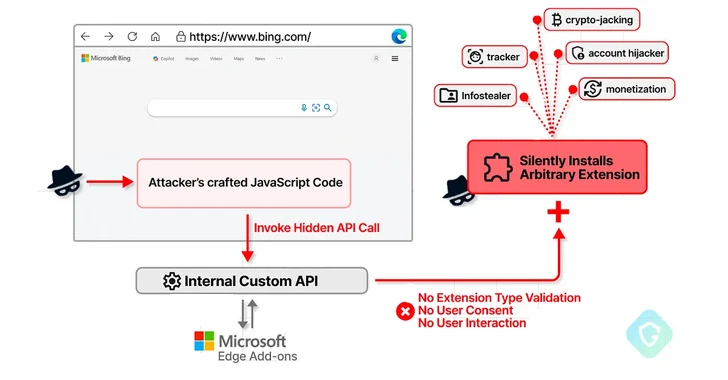
A now-patched security flaw in the Microsoft Edge web browser could have been abused to install arbitrary extensions on users’ systems and carry out malicious actions. “This flaw could have allowed an attacker to exploit a private API, initially intended for marketing purposes, to covertly install additional browser extensions with broad permissions without the user’s
Read More
Our mission is to educate our customer base, build capacity in every country we operate in and make cyber security affordable to all