
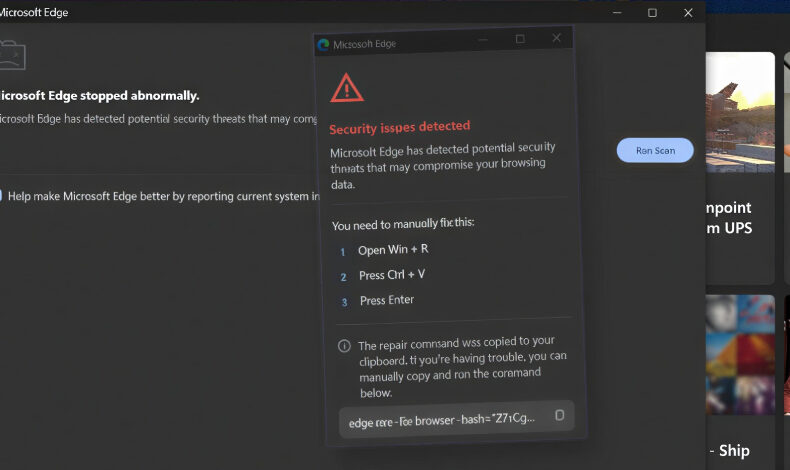
Cybersecurity researchers have disclosed details of an ongoing campaign dubbed KongTuke that used a malicious Google Chrome extension masquerading as an ad blocker to deliberately crash the web browser and trick victims into running arbitrary commands using ClickFix-like lures to deliver a previously undocumented remote access trojan (RAT) dubbed ModeloRAT. This new escalation of ClickFix, observed
Read More
Fortinet has released updates to fix a critical security flaw impacting FortiSIEM that could allow an unauthenticated attacker to achieve code execution on susceptible instances. The operating system (OS) injection vulnerability, tracked as CVE-2025-64155, is rated 9.4 out of 10.0 on the CVSS scoring system. “An improper neutralization of special elements used in an OS command
Read More
Cybersecurity researchers have discovered a JScript-based command-and-control (C2) framework called PeckBirdy that has been put to use by China-aligned APT actors since 2023 to target multiple environments. The flexible framework has been put to use against Chinese gambling industries and malicious activities targeting Asian government entities and private organizations, according to Trend Micro. “PeckBirdy is a script-based framework
Read More
Cisco has released updates to address a medium-severity security flaw in Identity Services Engine (ISE) and ISE Passive Identity Connector (ISE-PIC) with a public proof-of-concept (PoC) exploit. The vulnerability, tracked as CVE-2026-20029 (CVSS score: 4.9), resides in the licensing feature and could allow an authenticated, remote attacker with administrative privileges to gain access to sensitive
Read More
Our mission is to educate our customer base, build capacity in every country we operate in and make cyber security affordable to all